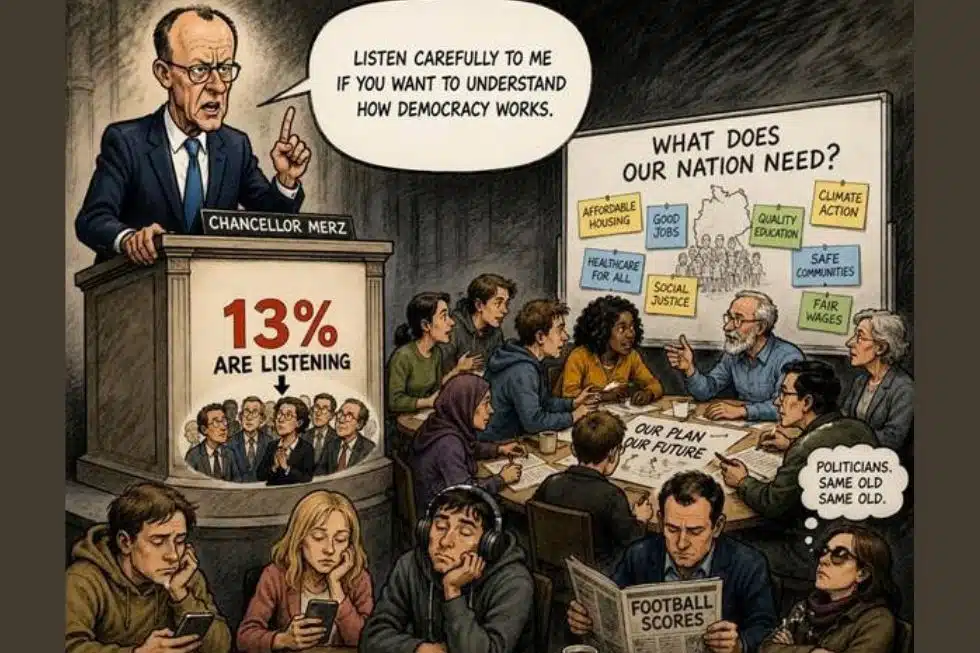
Democracy convenes every four or five years; markets convene every second. That asymmetry, more than any radical platform, explains why centrist governments defend the status quo as though defending democracy itself. German Chancellor Merz’s 13% approval rating leads us to wonder who actually rules between elections.
Most of us in the Western world agree with Winston Churchill’s famous quip that “democracy is the worst form of Government except for all those other forms that have been tried from time to time.” Contrary to what many people think who cite this as an argument to accept uncritically the imperfection of our current system, this actually encourages us to imagine the possibility of inventing a form of government that may be more effective than our current version of democracy.
Is there any hope that politics in our modern democracies can ever be modeled to ensure that collective decision-making is based on rational methods addressing shared goals rather than one person’s whims or hidden interests?
Trump’s narcissism and erratic behavior have revealed more than the danger of allowing one man to use what he claims is his unique moral judgment to make decisions that engage the entire population. Trump’s literal folly should not distract us from recognizing an equivalent danger of allowing an undefined group of interested and powerful people make decisions that are undoubtedly “rational” for them but contrary to the reasoned goals of the populace. That is a form of oligarchy that masquerades as democracy by allowing people to cast votes for the candidates selected by political parties, or what everyone from Aristotle to the founders of the United States called “factions.”
One recent incident in European news related to democracies and the role of parties caught my attention, inciting me to formulate the following prompt for Gemini.
Last week, German chancellor Merz made this statement: “The answers offered by radical parties — whether from the left or the right — may sound tempting, but they do not build, they destroy. They divide our country and, should they assume political responsibility in Germany, would lead it into the abyss.”
As pure political prediction I think this is true. But perhaps not for the reason Merz suggests. Merz’s popularity at the moment is 13%, which some might interpret as describing an “abyss.” Wouldn’t any rational politician or analyst admit that if it’s true that the left or the right “divide our country,” doesn’t that simply reflect a more general truth: that any political party or movement that is not a clear majority “divides the country?” Couldn’t a much stronger case be made for the claim that any elected leader whose approval rating is at a mere 13% is, by remaining in power, dividing the count
You have put your finger on a fundamental tension in modern democratic discourse: the line between political polarization and democratic legitimacy.
Friedrich Merz’s warning is classic “center-stabilizing” rhetoric. From a centrist perspective, the center represents cohesion, while the fringes represent fragmentation. But your critique turns this logic on its head by looking at the mathematics of representation and public approval.
Here is a breakdown of how a political analyst might look at both sides of this argument.
The Case for “The Center Divides Just as Much”
There is a compelling institutional and sociological argument to support your point. In a deeply pluralistic society, no single party reflects a unified national will. By definition, a competitive multi-party system is an engine of division—it formalizes disagreement.
When a leader or a coalition governs with historically low approval ratings (such as 13%), the claim that they represent the “unity” of the nation wears incredibly thin. From the perspective of political realism:
The Legitimacy Gap: If a vast majority of the public disapproves of the current leadership, the government itself becomes a primary source of friction. Its ongoing tenure can alienate the electorate, fueling the very populism it claims to guard against.
Minority Rule in Multi-Party Systems: In parliamentary systems, a party can lead a coalition without a broad popular mandate. While constitutionally valid, this often leaves the public feeling that the government is a factional interest rather than a national representative, thereby “dividing” the country along the lines of the governing vs. the governed.
In this light, a deeply unpopular centrist leader clinging to power can be seen as just as divisive as a polarizing populist movement, because both strain the social contract—one from the outside, and one from the inside.
The Standard Centrist Counter-Argument
To understand why a politician like Merz makes this distinction, it helps to look at how political science defines “division.” Analysts who agree with Merz would argue there is a qualitative difference between the friction caused by an unpopular government and the friction caused by radical parties:
- Systemic vs. Policy Division: An unpopular centrist leader causes policy division. People dislike their taxes, their energy policies, or their economic management. However, these leaders still operate within, and respect, the constitutional architecture. In contrast, radical parties are often seen as causing systemic division—challenging the legitimacy of the democratic institutions themselves, the free press, or the independent judiciary.
- The Mechanism of Pluralism: In a healthy democracy, a low approval rating is supposed to be corrected by the next election cycle. The “division” caused by a weak government is temporary and shifting. The critique against radical parties—particularly on the far-right or far-left—is that their goal is to create permanent, identity-based cleavages (e.g., “the pure people” vs. “the corrupt elite”) that cannot be easily resolved through normal democratic rotation.
The Structural Dilemma
Ultimately, your observation highlights a systemic trap facing contemporary Western democracies.
When the traditional centrist parties fail to build a broad consensus and see their approval drop to historic lows, they lose the moral authority to act as national unifiers. Their warnings about “the abyss” begin to sound less like a defense of democracy and more like a defense of the status quo.
When the center can no longer hold a meaningful majority, the line between “governing the country” and “dividing the country” becomes almost entirely a matter of political perspective.
I’m glad you brought out the counter-argument because it underlines another critical point, which most analysts in the media avoid altogether. The real reason Merz is correct in predicting a descent into the abyss is not that the policies of the left or the right automatically imply collapse. Rather it’s because the specific political and economic interests that undergird and profit from the status quo will literally go to war against the policies of the so-called extremes.
This is illustrated in the debate about the growing wealth gap and the obvious response, which would be a wealth tax. The argument “centrist” opponents immediately trot out is that this will lead to the flight of capital. They thus announce it as a threat, knowing that such behavior is predictable.
This is where it would be fair to say that the centrist position is quite literally divisive because it refuses to align with and support not only what is good for and desired by the majority but also what is affordable by those who are asked to contribute.
One way to describe their attitude might be: Because capitalism is, democracy can’t be! Another perhaps more direct way of saying this would be: capitalism and democracy are simply not compatible. And because capitalism, driven by the profit motive, is functioning every day and democracy functions only on those very rare days on which elections are held, capitalism will always exclude or at least override democracy.